There is a federal grant that can pay for security cameras, door access control, and lighting at a house of worship, such as a church or a synagogue, or at a nonprofit school. In Georgia, the last window to apply for it opened on June 26, 2026, and applications were due July 15. In that window, an applicant had to get the state a mission statement and, for each building, a vulnerability assessment and an investment justification, the form that lays out the project. Leaving out any one of them forfeited the application.
The window before that ran about seven weeks, from October 1 to November 17, 2025. Over the last five rounds, Georgia’s window has opened in five different months, March, April, May, June, and October, and the shortest ran from May 16 to May 31, 2022. As of October 2026, no Georgia window is open, and no date has been published for the next round. In 2026, the state opened its window two days after the Federal Emergency Management Agency, FEMA, posted the program’s notice, so the slow parts are worth doing before the notice appears. FEMA’s own checklist says the vulnerability assessment can be done “at any time in the year, regardless of whether the NSGP’s application period is open.”
My company designs, installs, and services security systems around metro Atlanta, for customers that include houses of worship and religious schools. The program facts below come from FEMA, the state, and the Cybersecurity and Infrastructure Security Agency, or CISA, and I give the year each one comes from, because FEMA issues a new notice every round and the 2026 notice changed some of the numbers. The advice on planning a project is mine.
The short version. The federal Nonprofit Security Grant can pay for cameras, access control, lighting, impact-resistant doors and gates, and intrusion alarms at a nonprofit such as a house of worship or a religious school. In 2026 the limit was $200,000 per site. In Georgia you apply through the state, its windows over the last five rounds ran from about two weeks to about seven, and the next one has no published date. Four pieces can be done before any window opens: a vulnerability assessment for each address, a project list tied to what it found, a mission statement, and a free federal ID number called a UEI. Two things to avoid: buying anything for the project before an award, and letting a contractor you hope to hire for the work help write your application, project plan, or budget. And if what you need is security officers, Georgia’s separate state grant for them closes Friday, October 30, 2026.
What the Nonprofit Security Grant Is
FEMA runs the Nonprofit Security Grant Program, but a house of worship or a school does not apply to FEMA. It applies to its state. In Georgia that is the Georgia Emergency Management and Homeland Security Agency, GEMA/HS, which sets a deadline earlier than the federal one and scores the applications first.
To apply, an organization has to be a 501(c)(3) nonprofit, so a for-profit school does not qualify. A house of worship that meets the 501(c)(3) requirements is exempt automatically, and the IRS does not require it to apply for a letter saying so. The application also has to show, in the 2026 notice’s words, that the organization is “at high risk of a terrorist or other extremist attack.” The state scores that part on how well the application identifies the risks the organization faces and backs them up. The notice names houses of worship and educational facilities among its examples of organizations that can apply.
Three more things decide where you stand:
- Which pool you are in. The Atlanta Area is one of the urban areas the 2026 notice designates, so nonprofits inside it apply in the urban-area pool, and nonprofits elsewhere in Georgia apply in the state pool. Applying in the wrong one disqualifies the application, and the notice does not list the counties, so step one below is to ask.
- What kind of organization you are. In the 2026 notice, the state’s score is multiplied by three for religious organizations, including religious schools, by two for secular schools and medical facilities, and by one for everyone else. The state checks your category against your mission statement.
- It is a competition. The state scores the applications, and they are funded from the top score down until the money runs out. In 2026, an organization that had never received the grant got 15 bonus points, and in a tie, organizations that did not receive funding the year before came first.
What It Pays For, and What It Does Not
Under the 2026 notice, the grant pays for equipment from a federal list, and for installing it, on property the nonprofit owns or leases. These are the lines a house of worship or school is most likely to use:
- Cameras. The list’s wording is “Camera-based security systems utilizing standard, low light, or infrared technology.”
- Access control. “Locking devices and entry systems for control of physical access to facilities.”
- Lighting. Fixed lighting for building perimeters, parking lots, and similar areas.
- Doors and gates built to resist impact.
- Intrusion alarms, with sensors such as door and window switches and motion detectors.
Maintenance contracts, warranties, and repairs are allowable too. According to FEMA, the equipment nonprofits asked for and received the most in the 2025 round was video systems, impact-resistant doors and gates, access control, barriers, and fixed lighting.
The 2026 notice also allows contracted security personnel, though not equipment for them. Georgia’s application for its own state grant says that, unlike the federal grant, the state grant allows hiring off-duty law enforcement officers, so if people are what you need, ask GEMA/HS which program fits.
Some things are off the list, and the notice is direct about two of them: “License plate reader and facial recognition software are NOT allowed.” Anything that is not on the federal list needs FEMA’s approval before it is bought. The program also requires compliance with Section 889 of the 2019 defense authorization act, which restricts the purchase of certain covered surveillance and telecommunications equipment. The notice names the law and lists no brands, so ask anyone who quotes your project to confirm in writing that what they are quoting complies.
Georgia’s State Grant Closes Friday, October 30
Georgia also runs a separate program, the Funds for Protection of Communities grant. Its current round takes applications through Friday, October 30, 2026, at 11:59 p.m., online through the state’s grants system. It pays only for security personnel, such as contracted security guards and off-duty law enforcement officers, at one facility per applicant, with awards of up to $150,000. It is a reimbursement grant, so the organization pays first and is paid back. It does not pay for cameras, access control, or alarms. The details are on the state grant’s page, and if you are applying, confirm the exact deadline with GEMA/HS.
What to Do Now
- Email or call GEMA/HS. The address is hsgrants@gema.ga.gov, and the phone is 404-635-7068. Ask whether your address is in the Atlanta Area pool, whether the state wants the vulnerability assessment in a particular format, whether you need a UEI to apply or only to receive an award, how award money is paid out and for how long, and, if you need guards, which program fits.
- Look into a UEI. A Unique Entity Identifier is the federal government’s ID number for an organization, issued free through SAM.gov, the federal registration site. FEMA’s guide for the 2025 round said it “may take four weeks” to get one, and that a nonprofit did not need it to apply but did need it to receive the money.
- Assess each building. The 2026 notice required one assessment and one investment justification for every address, so a preschool in a separate building at its own street address needs its own. FEMA’s guide for the 2025 round listed the kinds of assessment it would take: the free CISA self-assessment, an assessment by state or local law enforcement, an outside contractor’s assessment, or another valid method. Georgia’s grant page links CISA’s self-assessment for houses of worship, which calls itself “a first step” and says other nonprofits can use it too. CISA also describes a free walk-through of two hours or less by a trained assessor, called the Security Assessment at First Entry, for places such as houses of worship and schools, requested through CISA’s field staff or regional office; ask whether visits are being scheduled.
- Check before you hire an assessor. If you hire a company for the assessment, the assessment becomes part of your application, so the third rule below can apply to that company: ask GEMA/HS whether it could still bid on the work. The state also decides whether the report meets its requirement.
- Turn the findings into a project list, one line per item, each tied to something the assessment found. More on that below.
- Write or update the mission statement. Say plainly what the organization is and what it does, since the state uses it to confirm your category.
- Decide who owns the application, and have that person watch the GEMA/HS grant page, where Georgia posted the 2026 round.
Writing a Project List a Reviewer Can Follow
The 2026 notice tells reviewers to look for a match between what you ask for and what your assessment found. It is the same order I use to design any security system: the problem first, then the equipment.
A line a reviewer can follow names the problem, the place, and the fix. “New security cameras” does not. “Two cameras covering the preschool entrance and the drop-off lane, where the assessment found no view of who comes and goes” does. A few habits help.
- Pair cameras with light. On a December evening, a camera watching a dark parking lot will often switch to infrared and record in gray. If the assessment flags the lot, the lighting line and the camera line belong together, as I explained in the night vision post.
- Write down what each item has to do. Purchases under the grant have to follow federal competition rules, and among its examples of practices that restrict competition, the 2026 notice lists specifying only a brand-name product without allowing an equal one. Write “card access on the classroom wing’s outside door, locked from outside except at drop-off and pickup,” and if you name a model, say that an equal product is acceptable.
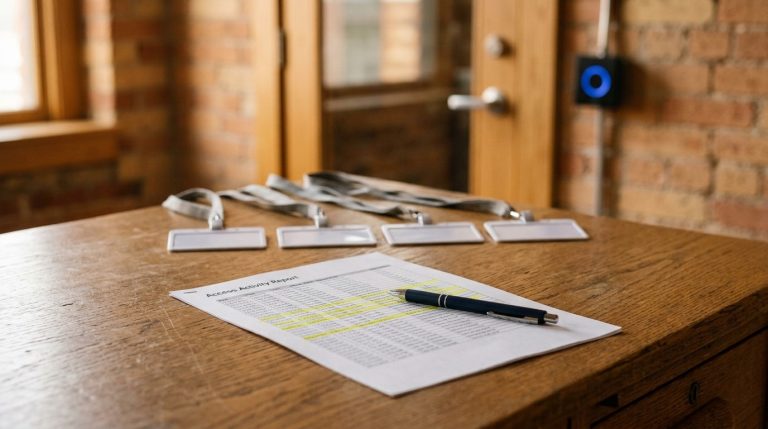
- Plan for the list of who has access. A card system needs an up-to-date list of who holds a card, and at a house of worship that list changes every time a staff member or a volunteer moves on. I wrote about keeping that list current in the offboarding post.
- Plan for the years after. The grant allows maintenance contracts, warranties, and user fees during the award period. For the 2026 round, GEMA/HS projected the federal period to end August 31, 2029, and step one asks how long an award would actually run. Budget for monitoring, cloud subscriptions, and service after it ends yourself.
Three Rules That Trip People Up
Do not buy early. The 2026 notice says: “Subrecipients cannot claim pre-award costs.” A subrecipient is an organization that receives an award through the state. A camera bought in March for a project funded in September is a camera the grant will not pay for.
Leave time for a review before work starts. Federal law requires an environmental and historic preservation review to be finished “before federal funds are released to carry out proposed projects,” and the 2026 notice says installing some equipment can trigger one. If your building is older or historically significant, build that review into the schedule.
Choose your helpers carefully. Purchases under the grant have to follow federal competition rules, and a contractor who writes the specifications or bid documents for a purchase cannot compete for it. FEMA “extends this restriction to contractors who assist recipients or subrecipients in developing grant applications, project plans, or budgets.” So a security company that helps write your application, project plan, or budget can end up unable to bid on the installation, or to be paid for it with grant money.
Where a Security Company Fits
Plenty of security work at a house of worship or a school never touches a grant: service on the system already in the building, or a project the organization pays for on its own schedule. That is where a security company can help you directly. If a grant is part of your plan, the third rule above applies to any company you let help with the application, project plan, or budget, mine included.
Frequently Asked Questions
Can a church or synagogue get a federal grant for security cameras?
It can apply for one. Under the 2026 notice, the federal Nonprofit Security Grant allowed camera systems, access control, lighting, impact-resistant doors and gates, and intrusion alarms, plus installation, up to $200,000 per site. The organization has to meet the 501(c)(3) requirements, and its application has to show, in the notice’s words, that the organization is “at high risk of a terrorist or other extremist attack.” Applications are scored against each other, so applying does not guarantee an award.
When is the next Nonprofit Security Grant window in Georgia?
No date had been published as of October 2026. Georgia’s last two windows ran from October 1 to November 17, 2025, and from June 26 to July 15, 2026. Georgia posts each round on the GEMA/HS Nonprofit Security Grant Program page, and questions go to hsgrants@gema.ga.gov.
What does a Georgia nonprofit need to apply for the Nonprofit Security Grant?
For the 2026 round, Georgia required three documents: an investment justification, a mission statement, and a vulnerability assessment, submitted online through the state’s grants system. Leaving out any of the three forfeited the application. Each address needed its own vulnerability assessment and its own investment justification.
Can we buy security equipment now and have the grant pay for it later?
No. The 2026 notice says subrecipients cannot claim pre-award costs, so equipment bought or installed before an award is not covered. An environmental and historic preservation review also has to be finished before federal funds are released for a project.
Can a security company help write our grant application?
If it does, it may lose the chance to do the work. Under the 2026 notice, FEMA’s procurement rule bars a contractor who helps develop a grant application, project plans, or a budget from competing for that work, and grant money cannot pay that contractor to do it. Ask GEMA/HS how the rule applies before any contractor you might hire helps with the application.
Start With One Building
Pick the building that matters most to you and walk it with the self-assessment before the end of November 2026, on an ordinary weekday, with whoever opens and locks it. Then send GEMA/HS the questions in step one.
If you would like to talk about the system in your building today, or about work you plan to pay for yourself, we would love to talk with you about it. Call us at 678-924-7480 or email service@verifiedsecurity.com. And if an award comes through and you would like a bid from us, we would be glad to give you one.
Current as of October 2026. We review this post annually, and again when FEMA posts its next notice for this program.
Scott Hightower founded Verified Security in 2007 and has spent nearly two decades designing, installing, and servicing commercial security systems across metro Atlanta. Verified Security is an authorized Honeywell security provider and specializes in access control, video surveillance, intrusion, and fire alarm systems. Reach Scott’s team at 678-924-7480.