Somewhere in your building there is a battery that has been waiting years for one job. It sits inside your alarm panel, trickle-charging, and the night the power goes out it becomes the only thing standing between a working security system and a dark one.
Most owners have never been told what actually happens in that moment, and the honest answer is that there is no single answer. When a building loses power, every part of the security system starts a different clock. Some parts run for a day. Some run for hours. Some quit instantly, and one or two do something most people find surprising, which is unlock.
In an ordinary year this barely matters. The U.S. Energy Information Administration reports that routine interruptions cost the average electric customer about two hours a year. 2024 was the other kind of year. With Hurricane Helene and two other hurricanes doing most of the damage, total interruptions averaged eleven hours per customer, and plenty of Georgia buildings sat dark far longer than that.
I have designed, installed, and serviced commercial security systems across metro Atlanta since I founded Verified Security in 2007. Let me walk you through the outage the way the system experiences it, clock by clock.
The short version. During a power outage, a commercial fire alarm runs on batteries sized by code for 24 hours. A burglar alarm panel is designed to a 4-hour standard. Cameras, recorders, and network gear get nothing unless you gave them a battery of their own. Exit doors held by magnetic locks release when their power is gone, on purpose, for life safety. And through all of it, your panel is reporting its own outage to the monitoring center, if the path out of the building survived.
Every Part of Your System Is on a Different Clock
When a proposal says “battery backup included,” that is not one answer. It is four.
- Your fire alarm has the longest clock, because code demands it. NFPA 72, the national fire alarm code, requires backup power that can run the system in normal watch mode for a minimum of 24 hours, and still have enough left at the end to sound every horn and strobe for 5 full minutes, or 15 minutes if the building uses voice evacuation. The Electronic Security Association publishes a plain-English summary of the requirement if you want to check me.
- Your burglar alarm has a shorter clock than most owners assume. Commercial intrusion panels are listed to UL standards, and the listings manufacturers build to call for 4 hours of standby power. Four hours covers nearly every routine interruption Georgia Power will ever hand you. It does not cover a hurricane, and it was never designed to.
- Your cameras have no clock at all. No general building or fire code requires backup power for video surveillance, so unless somebody deliberately put your recorder and network switch on a battery, they stop the moment the building does.
- Your access control splits the difference. Some controllers carry a small battery of their own, while a growing number are powered from the same network switch as the cameras, which means they stay awake only if that switch does. The locks they command are another story, and they get their own section below.
Those numbers are design standards, not guarantees. A battery that has been sitting in the panel for a decade will not deliver the hours it was sized for, which is why the clocks in this post are the starting point for questions, not a reason to relax.
What to check: ask your security company which parts of your system have their own battery and which do not, in writing. If the answer arrives quickly, they know your system. If it does not, that is worth knowing too.
The First Hour: Your System Reports Its Own Outage
Here is the part of this story almost nobody writes about. A commercial alarm panel does not just survive an outage. It announces one.
The moment utility power fails, the panel registers a trouble condition for loss of AC power. On the fire alarm side, NFPA 72 expects supervising-station systems to hold that signal for a window of one to three hours before transmitting it to the monitoring center. That delay is deliberate: it keeps a stormy night from burying the monitoring center under a thousand identical signals, and it keeps your phone from ringing over a blink the grid fixes in twenty minutes. Burglar panels handle the same event by programming instead, so some report the moment the power drops and others wait a stretch your installer chose, which is worth asking about.
If the outage drags on, the battery becomes the next messenger: as it runs down, the panel sends a low-battery signal. Between those two signals, a monitoring center can know your building lost power, roughly how long it has been dark, and when the system is about to go quiet, without anyone driving to the site.
Whether anything useful happens next depends on something cheaper than any hardware in this post: the call list. A power-failure signal that reaches a monitoring center with a current list gets a phone call to someone who can act. The same signal against a list nobody has updated goes nowhere. The building did its job. The paperwork did not.
What to check: ask what signals your system sent during the last outage in your area. The answer exists, because monitoring centers log every signal they receive. If nobody can produce it, you have learned something about your monitoring.
What the Doors Do
An outage does different things to different doors, and it is worth knowing which is which before a storm rather than after one.
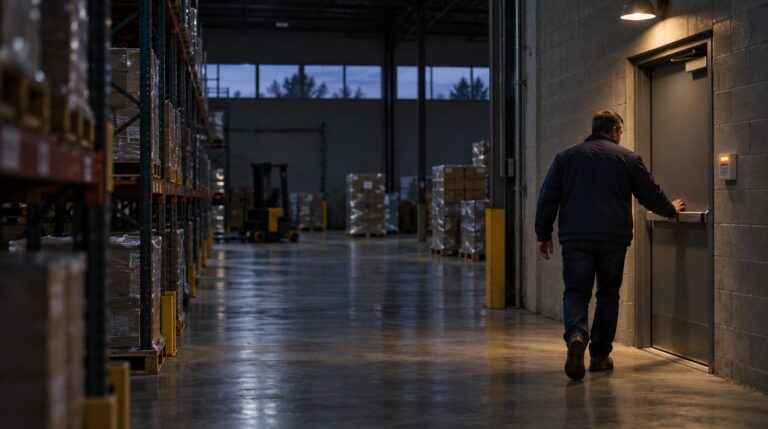
A magnetic lock holds a door closed with an electromagnet, which means it needs continuous power to stay locked. There is no fail-secure version of that physics. As the door hardware trade puts it, “when power is removed, the electromagnetic lock unlocks.” The building codes are written around that same behavior; the model egress rules for these doors require that “loss of power to the locking system automatically unlocks the door.” That is life safety working as designed, because in an emergency people must be able to walk out of a building without a working electrical system. A magnetic lock away from an exit route can sit on backup power and hold longer, which only sharpens the point: the lock holds exactly as long as something feeds it.
An electric strike is different. Most commercial strikes are installed fail-secure, which means the door stays latched when power is lost and a mechanical key still opens it from outside. Two doors that look identical from ten feet away can behave in opposite ways at the moment the lights go out. And remember the controller from the last section, because if it lost power with the building, the card readers stop reading, and the mechanical key becomes the plan. Somebody on your staff should know where that key lives.
What matters is knowing which doors do which. A building where somebody can name the doors that release on power loss, and who attends them during an extended outage, has a plan. A building finding out in the dark does not.
What to check: walk your exterior doors with your installer and have them mark each one fail-safe or fail-secure. It takes fifteen minutes and it turns a surprise into a checklist.
The Cameras Go Down With the Switch
Most commercial cameras today are powered over the network cable by the switch in your network closet, and the switch and the recorder are plugged into the wall like everything else. So when the building loses power, you do not lose your cameras one at a time. You lose them all at once, along with the recorder that would have been your record of the event.
I told you in an earlier post that your cameras are computers, and they fail like computers too.
Since no general building or fire code requires backup here, this one is a pure business decision, and my honest advice is to buy minutes where they count instead of trying to power everything. A UPS under the recorder and switch is carrying a real load, and at a real load its runtime is measured in minutes to tens of minutes, not afternoons. That is still worth having. Most of what the grid does to a metro Atlanta building is exactly that size: the blink, the five-minute drop, the twenty-minute repair. A right-sized battery rides through all of it and keeps the video that verifies an alarm available while the alarm system itself is still awake on battery.
What to check: if you have a UPS, look at the back of it. Most models have battery-protected outlets on one side and surge-only outlets on the other, and equipment plugged into the wrong side gets no battery at all. Then press its test button after hours rather than midday, because a failed test can restart everything plugged into it, and a UPS with a dead battery is furniture.
The Signal’s Path Out of the Building
Everything above is inside the building. Just as important is whether anything the panel says can still get out.
For most of my career, that question answered itself. An old copper phone line carried its own electricity from the phone company’s office, which is why, in the FCC’s own words, equipment on copper networks “continued to work during commercial power outages” at the customer’s end. The FCC wrote that in an order about what replaces copper, and it names the catch plainly: modern fiber and cable networks “do not provide power to operate necessary equipment at the subscriber location.” Your internet service now dies with your building’s power unless your modem has a battery, and as I covered earlier this summer, the copper lines themselves are being retired across Atlanta anyway.
This is why modern commercial panels communicate on two paths. Internet first, because it is fast and cheap. Cellular second, because the radio inside the panel runs on the panel’s battery, which makes it the one path that stays up when your building is dark. During an outage, a dual-path system loses its internet leg and keeps talking on cellular, on the same 4-hour clock as the rest of the burglar panel.
Cellular’s honest limit is at the other end of the signal. There is no federal requirement that cell towers carry backup power; a post-Katrina rule requiring 8 hours was challenged, never took effect, and was deleted in 2011. Helene’s numbers in Georgia tell both halves of that story: by the FCC’s final disaster-reporting numbers, about 93 percent of the 1,450 affected cell sites were working, a couple hundred of them on their own backup power. Cellular is the strongest leg your alarm has in a storm. It is just not a promise, which is one more reason the reporting signals in the first hour matter.
What to check: ask whether your panel has one communication path or two, and how the cellular unit is powered, because a radio built into the panel rides the panel’s battery while a standalone box with its own wall transformer may not. If your panel still reports over a phone line or internet alone, that is the first thing to fix, ahead of anything else in this post.
What Helene Settled
Georgia does not have to imagine any of this. Two years ago next month, Hurricane Helene was still at hurricane strength when it crossed into southern Georgia, according to the National Hurricane Center. That is how about 1.1 million Georgia customers came to be without power at the peak, per the Department of Energy’s situation reports. Georgia Power calls Helene the most destructive hurricane in the company’s history, and its final accounting shows why: nearly 12,000 broken poles and 1,500 miles of downed line, tallied this June alongside its storm-season preparedness push. Every battery in this post met a storm like that and lost, which is the honest scale to keep in mind.
The forecast for this season is genuinely calmer, and I want to be straight about that too. NOAA’s August update gives the Atlantic a 75 percent chance of a below-normal season. I read that as breathing room, not permission, because NOAA’s own leadership says it plainly: “It only takes one storm to make for a very bad season.” The statistical peak of the season lands on September 10, but Georgia’s outages were never only about hurricanes anyway. Winter Storm Fern took down power to more than 214,000 Georgia Power customers this past January with ice instead of wind. So a quiet forecast is the best possible weather for checking batteries.
Where a Security System Is Not Your Outage Plan
I would rather draw this line myself than let a proposal blur it.
A security system is built to ride through an outage and report it. It cannot end one, and it cannot run your business through one. The panel’s battery keeps the panel alive; it will not keep your coolers cold, your tenants comfortable, or your registers open. If your building needs to operate without utility power, that is generator and transfer-switch territory, and it belongs to your electrician, not your security company.
The battery math also has a ceiling. A multi-day outage outlasts every battery described in this post. Batteries are for bridging and reporting; in an outage measured in days, the system’s job is to tell you it is going down, early and cleanly, so people can take over.
And if your building runs staffed around the clock, some of this list simply matters less for you. People act on outages faster than panels report them. In that building I would still want the fire clock, the door walk, and the two-path communicator, but I would not sell you a UPS for every closet, and I would tell you so.
One thing that does keep earning its keep in the dark: the water and temperature sensors I covered in my last post ride the same panel battery. In an outage, the sensor watching your walk-in cooler is running on the very clock this post is about, which is either a comfort or an argument for a fresh battery, and in my experience it is both.
What to check: if the answer to “what happens when the power goes out” in your business currently lives in one person’s head, get it onto one page. Which doors release, who gets called, what the panel will report, and when the batteries quit. That page costs nothing and outperforms most hardware.
What I’d Check Before September 10
None of this requires a storm to find out, and all of it is easier on a calm Tuesday.
- Ask for the date on your panel battery. Sealed batteries are stamped with their month and year of manufacture, and the fire code expects them replaced on the manufacturer’s schedule, which in practice runs three to five years. Have your security company read the stamp at the next visit rather than opening the cabinet yourself, because panels are tamper-protected and, on the fire side, licensed territory. If the date is older than your phone, start there.
- Get the runtimes in writing. Not just where the batteries are, but how long each is designed to run and when each was last replaced, across fire, intrusion, cameras, and access. One email produces the reply, and the reply is your outage page started.
- Have your security company run a battery test. They can put the system on standby power, coordinate with the monitoring center, and confirm afterward that the trouble signal was received and who would have been called with it. Because power-failure signals can be held for a stretch before transmitting, depending on the panel, this is a scheduled test, not a light switch you flip and watch. A signal path you have never tested is a signal path you are hoping about.
- Decide who attends the doors. A door that releases on power loss stays released until the power comes back, so somebody needs to keep an eye on it in the meantime and check the building over once it does. Put a name on that now, along with the after-hours number that reaches them.
- Update the call list. Every signal in this post ends at a phone number. If the first name on the list left the company, the rest of the engineering is decoration.
Frequently Asked Questions
Do business security systems work when the power is out?
The alarm panels do, for a while. A commercial fire alarm is required by code to run at least 24 hours on backup power, and burglar alarm panels are designed to a 4-hour standby standard. Cameras, recorders, and access control equipment stop immediately unless they have their own battery, and monitored panels with cellular backup keep reporting while the panel battery lasts.
How long does a security system battery last in a power outage?
Fire alarm batteries are sized by NFPA 72 for a minimum of 24 hours of standby. UL-listed commercial burglar panels are designed for 4 hours. Those are design standards for a healthy battery, and an aging battery delivers less, which is why the manufacture date stamped on the battery matters as much as the specification.
Do security cameras record during a power outage?
Usually not. Most commercial cameras draw power from the network switch, and the switch and recorder fail with the building unless they are on an uninterruptible power supply. A right-sized UPS keeps recording through short interruptions and lets the recorder shut down cleanly in long ones, but at real camera loads its runtime is minutes to tens of minutes, not hours.
Do electronic door locks unlock when the power fails?
Magnetic locks on exit routes do, by design. They hold only while powered, so egress codes are written around their releasing when power is lost, which lets people exit safely. A maglock fed by backup power holds as long as that power does. Most electric strikes are installed fail-secure instead, staying latched with a mechanical key override. Know which doors are which before an outage, not during one.
Will my alarm still reach the monitoring center during an outage?
Usually, but it depends on how the communicator is powered. A cellular radio built into or wired to the panel runs on the panel’s backup battery and keeps reporting while that battery lasts. A standalone communicator with its own wall transformer can fail with the building unless it has a battery, and internet-only connections typically die with the modem, which is why dual-path communication with cellular backup is the standard worth insisting on.
Let’s Find Out on a Calm Day
The night the power goes out is a bad time to learn any of this, and a mild forecast is a good season to learn all of it.
If you want to know what your building would actually do, contact us and we will find out together. We will read the date on your panel battery and tell you whether it has the years left that the spec assumes. We will run a battery test coordinated with the monitoring center, then confirm the trouble signal was received and that the call list behind it still matches your staff. We will walk your electronically locked doors and mark which ones release. And we will tell you which parts of your system have no battery at all, so the gaps are decisions instead of surprises.
If everything checks out, we will tell you that too, and you will have your outage answer on one page. We have protected Atlanta businesses since 2007, and I would rather test your batteries on a quiet afternoon than have a storm do it for us. Reach my team at 678-924-7480.
Current as of August 2026. We review this post annually.
Scott Hightower founded Verified Security in 2007 and has spent nearly two decades designing, installing, and servicing commercial security systems across metro Atlanta. Verified Security is an authorized Honeywell security provider and specializes in access control, video surveillance, intrusion, and fire alarm systems. Reach Scott’s team at 678-924-7480.