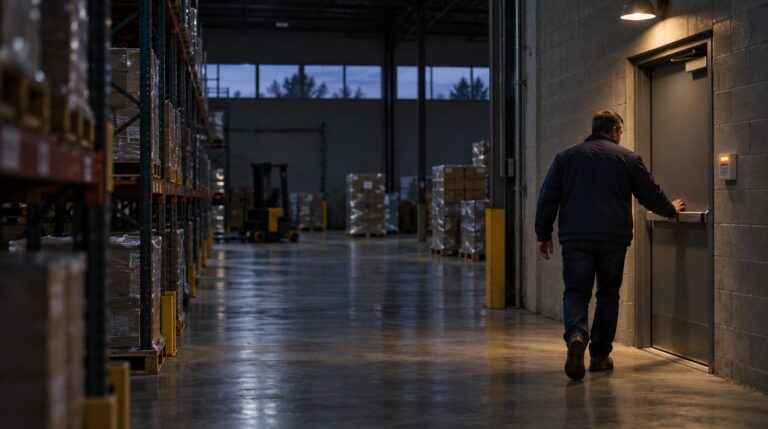
A building that locks up at six on Friday evening and opens at six on Monday morning spends 60 hours with nobody in it. Over a school break that runs into the hundreds, and a tenant suite between leases can sit for a month.
Your security system is awake for all of it. It watches doors, watches motion, and reports to a monitoring center around the clock, which makes it the one thing in the building that never goes home. So the question I wish I got asked more often is not whether it works. It is what else it could be watching.
Because the expensive thing that happens in an empty building is usually not a security event at all. A compressor quits, a supply line lets go above a ceiling, or the power blinks on Saturday afternoon and comes back without the rooftop unit. None of that trips a motion detector, so nobody finds out until somebody walks in Monday morning and smells it.
I have designed, installed, and serviced commercial security systems across metro Atlanta since I founded Verified Security in 2007. Let me sort this the way I would on a walk through your building.
The short version. Water, temperature, and humidity sensors are ordinary inputs on the same panel that already watches your doors, and they report over the same connection to the same monitoring center. The industry calls this convergence. On a Saturday it means the system you already pay for takes a second job, and somebody gets a phone call while the problem is still small.
What “Unified” Really Means on a Tuesday Morning
Start with what this looks like on a walkthrough, because the industry word for it is not much help. The alarm is on one login, the cameras are on a second, and the card access runs on a third, so when something happens at eleven at night, whether anybody acts on it depends on which of those three the right person happened to have open. Somewhere in the middle of that there is usually a notification list nobody has touched since the system went in.
I have been making this complaint for a while. I wrote back in 2019 that plenty of our customers were running alarm, camera, and card access as three stand-alone systems with three logins, and what has changed since then is not the argument. It is the price and the effort of doing something about it.
The industry has since caught up to the complaint and given it a name. The Security Industry Association publishes an annual list of what it expects to shape the year, and three of the ten it named for 2026 are about systems that used to be separate ending up in the same place. The one that matters most for a building like yours says security is expanding into a holistic ecosystem “that integrates building systems, IT infrastructure and operational technologies.” That is a long way of saying something simple. Your panel, your cameras, your door controllers, and the equipment sitting in your mechanical room are all becoming one conversation instead of four.
I will give that report credit for something the marketing around it usually leaves out. It says the goal is not a “single pane of glass” but “a smarter, more intuitive interface,” and I would put it plainer still. Nobody needs one screen. What a building needs is one place where the alert lands and one current list of who gets called. The report also says unified platforms now “democratize advanced capabilities once reserved for enterprises with deep resources,” which is the part that actually changes my quotes: a 40,000 square foot building can buy this year what only a corporate campus could justify a few years ago.
Where I’d start: count your logins. If the number is greater than two, you have found the actual project, and it is a smaller one than you think.
The Sensors Are the Cheap Part
Here is what we are actually talking about, physically.
- Water sensors. A small puck that sits on a floor, or a rope you run along the base of a wall so it catches a leak anywhere along its length.
- Temperature sensors. A probe that reports the number and trips at high and low limits you set.
- Humidity sensors. The same idea, applied to moisture in the air.
- Low-temperature sensors. The simplest device on the list, with one job: telling you a space is heading toward freezing.
Every one of them is a supervised input on the same commercial panel that already watches your doors, run on the wire types your installer already pulls, reporting over the communication path that already carries your burglar alarm to the monitoring center.
None of this is new, and I want to be honest about that instead of dressing it up. I wrote a post on this blog about monitoring for more than security in 2012, and another one in 2013 about tying a sensor to a notification so you get a text when something changes. The sensors have gotten cheaper and more reliable, but they are the same idea.
What actually changed is where the alert goes. In 2012 an environmental sensor sent you an email, and that was the whole story. Now the same signal can land next to your access events and your camera footage, in the app you already open, with an escalation list behind it and a monitoring center at the end of it. The trade press calls that the Internet of Things. In a mechanical room it is a sensor, a wire, and a panel that already knows how to call somebody.
Where I’d start: price the contents of the room, not the sensor. A network closet holding a switch, a server, and your video recorder usually adds up to more than the entire monitoring package, and that math makes the decision for most owners in about a minute.
The Rooms Nobody Walks Into
The value here is not spread evenly around a building. It concentrates in the rooms people enter about once a month, which are the same rooms where things quietly fail.
- The mechanical room and the water heater closet, particularly where there is finished space underneath them.
- The sprinkler riser room, which tends to be the coldest room in the building with the most water in it.
- The network closet, generally the smallest room you own and the one holding the most expensive contents per square foot.
- Anywhere a roof drain comes down inside a wall.
- Loading docks, unheated garages, and stair towers, which run cold for the same reason they are convenient.
That last group is not my list, it is the fire protection world’s. NFPA 13, the sprinkler installation standard, requires water-filled systems to be kept at a minimum of 40 degrees unless an approved antifreeze solution is used, and NFPA 25, the inspection standard, expects piping in spaces that run colder to be held between 40 and 120 degrees. NFPA 72, the fire alarm code, goes a step further and includes a room temperature supervisory device, whose entire job is to signal when a room holding sprinkler equipment gets too cold. All three are readable free on NFPA’s site if you want to check me, and the edition your building answers to is whichever one your jurisdiction has adopted. The people who write them settled a long time ago that a cold room is worth a signal.
Georgia tests that conclusion most winters. This past January the governor declared a statewide state of emergency ahead of Winter Storm Fern and warned that prolonged freezing could burst pipes, then declared a second one eight days later ahead of the storm behind it. Those orders were about keeping people safe on the roads and in their homes, and the warning about pipes was a small part of them. It is the part that matters in an empty building, though, because a frozen line does not stay frozen. It thaws, and then it runs until somebody finds it.
Where I’d start: the sprinkler riser room and the water heater closet. If you protect only two rooms in your building, those are the two.
The Alert Nobody Received
A sensor that detects something and tells nobody is a decoration. I have seen more of those than I would like, and it is almost never the sensor’s fault.
Three things break the chain, and I run into all three regularly.
- The notification list. It was built the week the system went in and nobody has touched it since, so the first name on it belongs to a manager who left in 2022.
- Thresholds nobody tuned. The cooler alarms every time somebody props the door to unload, so within a month everybody has learned to swipe the alert away without reading it.
- The communication path. If your panel still reaches the monitoring center over a copper phone line, that line is on a retirement schedule, and a sensor riding a dead path is worse than no sensor because you believe you are covered. I wrote about the copper retirement and what it does to alarm communications earlier this summer.
There is also a difference worth understanding between an app notification and a monitored signal. An app notification goes to a phone, and phones are on silent at two in the morning. A monitored signal goes to people whose job is to be awake, who work a call list until somebody answers. For a walk-in cooler holding a weekend’s inventory, or a network closet, that difference is the whole product.
Where I’d start: ask what each alert you already have is set to trip at, and whether anybody chose that number on purpose. Most of them are still sitting on whatever was on the installer’s screen the day it went in.
Let the Camera Answer the Question
Here is where putting these on one platform stops being a convenience and starts being the point.
A temperature alert tells you a number crossed a line. It cannot tell you why, and why is what decides whether somebody drives in. If the same alert can hand you a camera view of that room, you know in about four seconds whether you are looking at a propped door, a puddle spreading across a floor, or a reading that is about to correct itself. That industry report I mentioned uses this exact pairing as its example of boundaries dissolving: data centers where “cameras validate alerts from environmental sensors.”
We have been making that argument under a different name since we opened. Confirm first, then act. It is the same logic behind verified alarm response, and it is where our name comes from.
Two honest limits. A camera only helps if there is one pointed at that room, and mechanical rooms are exactly where nobody put one. And confirmation is not a substitute for going. If the video shows water on a floor, somebody still has to get there.
Where I’d start: pick your two most expensive rooms and make sure each has both a sensor and a camera view. Two rooms is a real project you will finish.
Where a Security Panel Is Not the Right Tool
I would rather tell you this now than have you find out later.
A security panel is an alerting device. It is not a compliance logger. If you store vaccine, the CDC describes a digital data logger that can record “at least every 30 minutes,” typically using a buffered probe, and notes that standard thermometers “typically measure air temperature” instead. Providers who administer publicly funded vaccine have further requirements set by their state immunization program. A food service operation has its own temperature records to keep. In every one of those cases the logger is the record and the panel is the alarm, and you want both, because a logger that documents a twelve-hour excursion nobody knew about has documented a loss.
A security panel is also not a building automation system. It will tell you the room is 84 degrees. It will not start a compressor, and if somebody sells you a sensor as a fix for aging equipment, the sensor is going to keep reporting the same thing every August. Sensors buy you time and evidence. They do not buy you a new rooftop unit.
And it is not a reason to spend money you should not spend. If your building is occupied around the clock and every critical space has somebody in it, sensors will earn less here than they do for a warehouse that goes quiet Friday night. I would rather tell you that than sell you twelve of them.
Where I’d start: ask whoever quotes you which of these three things the device actually does. The answer is a fast read on who you are dealing with.
What I’d Turn On This Week
The order matters more than the pace, because each of these makes the next one easier.
- Fix the notification list before you buy anything. Names, mobile numbers, and the order they get called, checked against your current org chart. It takes twenty minutes and costs nothing, and every other item below is worth very little until it is done.
- Find out what your panel will already accept. Ask how many open zones you have and whether it takes environmental inputs. This is the answer that decides whether the rest of the list is a configuration job or a hardware job, and more often than not it is configuration.
- Walk the building and write down the rooms you enter less than once a week. Most buildings produce five or six. That list, in that order, is your sensor plan, and it usually costs less than people expect.
- Cover water before you cover temperature. Both are worth doing, but the clocks are different. A temperature problem usually gives you hours to react, and a broken supply line gives you minutes. Temperature can wait until next month. Water should not.
- Trip a sensor at ten at night, on purpose, before you are relying on it. See who actually gets woken up. Better to learn that on a quiet Tuesday than during the first freeze warning of the winter.
Frequently Asked Questions
Can my business security system monitor water leaks and temperature?
In most cases yes. Water, temperature, humidity, and low-temperature sensors are standard supervised inputs on commercial alarm panels, and they report over the same communication path as your burglar alarm. Whether your specific panel supports them depends on its age and available zones, which is a quick thing to check before you spend anything.
What are environmental monitoring sensors?
They are devices that watch a physical condition instead of a person. A water sensor detects a leak on a floor or along a length of rope cable. A temperature sensor reports the number and trips at high and low limits you set. A humidity sensor tracks moisture in the air. Each one becomes a zone on the panel and can generate an alert or a monitored signal.
Where should you put water sensors in a commercial building?
Start with the rooms nobody visits often and the ones with plumbing above finished space: water heater closets, mechanical rooms, sprinkler riser rooms, network and server closets, and anywhere a roof drain runs inside a wall. Loading docks, unheated garages, and stair towers matter most for low-temperature sensors, because those spaces run cold.
Will a temperature sensor satisfy a compliance requirement?
Usually not by itself. Programs like vaccine storage call for a calibrated digital data logger that records at set intervals, and that device is the official record. A security panel sensor is the alarm layer that tells somebody in time to act. Most operations that get this right run both, because the record proves what happened and the alarm prevents it.
What is a unified security platform?
It is an arrangement where access control, video, intrusion, and sensor alerts land in one place with one set of users and one notification list, instead of three systems with three logins. The practical benefit is not the screen. It is that one event can pull the related video with it, so a person can decide what to do without opening anything else.
Let’s Walk the Rooms You Don’t Walk
Most buildings I go into already own most of what is in this post and have never had it turned on.
If you want to know what yours can do, contact us and we will find out together. We will look at your panel and tell you how many open zones you have and whether it supports environmental monitoring sensors. We will walk the rooms you visit once a month and tell you which ones are worth a sensor and which ones are not. We will check your notification list against your current staff, and we will test the communication path, because a sensor on a dead path is worse than nothing.
If your system is already set up this way, we will tell you so and you are done. We have protected Atlanta businesses since 2007, and I would rather look at your mechanical room on a quiet Tuesday than get the call on a Saturday. Reach my team at 678-924-7480.
Current as of August 2026. We review this post annually.
Scott Hightower founded Verified Security in 2007 and has spent nearly two decades designing, installing, and servicing commercial security systems across metro Atlanta. Verified Security is an authorized Honeywell security provider and specializes in access control, video surveillance, intrusion, and fire alarm systems. Reach Scott’s team at 678-924-7480.