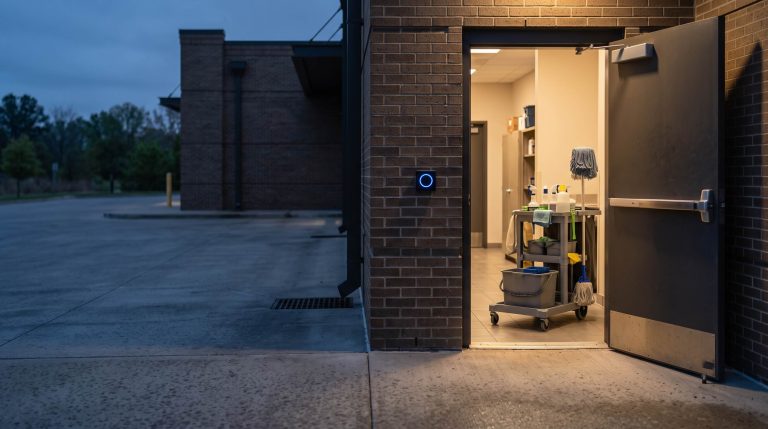
It usually starts with a simple question. A back door is found unlocked on a Friday morning, and the owner wants to know who used it the night before. The video lives in the camera company’s app. The door history lives in the access control portal. The alarm log lives at the monitoring center, one phone call and one hold queue away. Three systems, three logins, and when the answers finally come back, the door log and the video disagree about what time the door opened.
I see versions of that morning all the time, and the building’s story behind it is almost always the same. The fire alarm came with the building and its inspection contract. The burglar alarm predates the current tenant. The cameras arrived with a remodel, and the access control went in the year the key ring got out of hand. Every one of those decisions made sense on the day it was made, and for most of my career the systems genuinely were separate technologies. A building does not choose fragmented security. It accumulates it, one reasonable decision at a time.
I have been writing about this for a while. Back in 2019 I described customers juggling “three different logins or three different mobile apps” and running “three different reports to get data from three different systems,” and I called it what it was: not very efficient. Seven years later the tools have caught up, and so has the cost of leaving things stitched apart. I founded Verified Security in 2007 and have spent nearly two decades designing, installing, and servicing commercial security systems across metro Atlanta, so let me walk you through what integration actually fixes, and just as honestly, what it does not.
The short version. An integrated security system puts your cameras, door access, intrusion alarm, and, where the design calls for it, your fire alarm on one coordinated design with one accountable company. Events line up, the clocks agree, and there is one number to call when something breaks. It does not mean one brand of everything, it does not require ripping out equipment that works, and no code requires you to consolidate. What it fixes is the seams, and the seams are where the answers go missing.
How a Building Ends Up With So Many Security Systems
For most of the history of this trade, the systems were separate because they had to be. Cameras ran on coax to a recorder in a closet. The burglar panel talked to the monitoring center over a phone line. Card access was its own island with its own wiring, and fire alarm has always lived in its own regulated world. Companies specialized because the technology demanded it, and building owners hired by trade because that is how the companies came.
Then everything moved onto the network. Your cameras became computers. Your panel learned to report over the internet and cellular. Your door controllers started drawing power from the same switch as the cameras. Once every system became software on a network, the walls between them stopped being technical and started being contractual.
The industry has noticed. The Security Industry Association’s 2026 Security Megatrends report finds that small and midmarket buyers “increasingly prefer unified platforms that reduce complexity and eliminate the need to manage multiple vendors.” That preference is a recognition that the seams between systems now cost more than the differences between them.
The seam to check: pull your security invoices and count the companies that touch your building. Then ask yourself when any two of them were last in the building on the same day.
The Seams Are Where the Answers Go Missing
Go back to that unlocked door. The morning-after question is always assembled from pieces: what the camera saw, what the door controller logged, what the panel reported. In a fragmented building, each piece lives behind a different login, and the pieces do not agree about time.
The reason is arithmetic. Left unsynchronized, the clock inside a recorder or a controller drifts, and NIST, the federal measurement agency, puts drift for most ordinary hardware clocks at about 5 to 15 seconds per day. Set a recorder’s clock in January and by summer it can be minutes off, with each box in the building drifting in its own direction. The people who use recorded video professionally plan for this: the FBI’s guide for retrieving video evidence instructs responders to “compare the time displayed by the DCCTV system with the current time” and “document the difference, if any,” and the forensic community’s best-practice documents carry a dedicated worksheet line for the time offset. In other words, the professionals begin by assuming your clocks disagree.
An integrated design shrinks that problem, and I want to be straight about how. Even on one platform, the access controller and the video recorder each keep their own clock, so the fix is not the shared screen. It is the shared time source. The cloud-managed systems we sell and install synchronize regularly against time servers, which is why their clocks stay close, while standalone server-based systems can drift further unless somebody points them at one. The ONVIF standard that much modern video and access equipment supports defines standard commands for exactly that. Time is only the start. On one platform, the door event and the video are the same record: I wrote back in 2013 that linking access control and video makes “searching video for specific access control events” much quicker and easier, and that is still the plainest way to say it. The morning-after question collapses from three logins and a hold queue into one search.
The seam to check: open each of your security apps and compare its clock to the one on your phone. Two systems that disagree by minutes today will disagree about the next event too.
What “Integrated” Actually Means on a Proposal
The word gets used loosely, so let me define it the way I would on a walkthrough.
There are three levels. The first is seeing together: one app that shows your cameras and your doors. Convenient, but that is two systems wearing one coat. The second is working together: events cross from one system to another. A valid badge presented at the front door disarms the alarm in the same motion. A door forced open tells the cameras to mark the moment. This is where the everyday value lives. The third is being owned together: one design, one company accountable for the whole of it, one service relationship, and one test schedule. That last level is the one that changes whose problem your building’s seams are.
Here is what integration does not mean: one brand of everything. The industry built open standards precisely so it would not have to. ONVIF, founded in 2008, publishes conformance profiles for both video and access control equipment so gear from different manufacturers can interoperate, and OSDP, an international standard since 2020, does the same for the communication between card readers and panels. A system can be integrated without being captive, and a good integrator’s first instinct is to connect what you already own rather than replace it.
I will add one honest note from inside the industry. Even SIA’s own trend report cautions that the goal “is not a ‘single pane of glass’” and I agree with every word. A pane of glass is a screen. What you are actually buying is a design.
The seam to check: ask any bidder which parts of the proposed system follow open standards like ONVIF and OSDP, and what happens to your equipment if you and the company part ways someday. A confident answer to the second question is the best proof the first one was honest.
The Code Already Expects Your Systems to Talk
Here is where this stops being a convenience conversation, because in an emergency, the code puts your fire alarm in command of specific other systems.
Certain electrified door locks on exit routes are required to release when the fire alarm activates. The model building codes spell it out for those locking arrangements: “Activation of the building fire alarm system, where provided, shall automatically unlock the electric lock, and the electric lock shall remain unlocked until the fire alarm system has been reset.” Not every door and not every lock type, and the requirement applies where those systems exist, but where it applies, the fire alarm and the access control system are required to act as one machine. The fire alarm reaches other systems too: NFPA, the fire code’s publisher, describes the fire alarm panel controlling “elevator recall, automatic door closers, smoke control systems, and so on.”
NFPA says the next part better than I could: “When a fire alarm control unit controls another system, it is known as system integration. It is crucial that the fire alarm system along with all integrated systems are tested properly.” And testing is not optional. Facility-management guidance on fire alarm inspection is blunt that the annual test covers “all interfaces with other building equipment.”
Now picture where that interface physically lives. Typically it is a control module mounted beside the access control panel, wired across by whichever trade got there second. The engineering press has warned about what happens around that module when separate installers each own half of it and no one owns the whole. When the fire alarm company tests its panel and the access company services its own, the connection between them is the one thing on nobody’s work order.
To be precise about what the code says: no code requires you to hire one company. What the code requires is that the connection work, and that it be tested. Who makes both of those things true in your building is a question worth answering on purpose.
The seam to check: find your most recent fire alarm inspection report and look for the door locks and elevator functions on it. If nobody can say who tested the connection to the access system, ask for that interface to be on the next test.
One Number to Call
Some seams show up on the worst morning of the year. Most show up on ordinary Tuesdays.
A door will not latch. The access control company checks the controller and the controller is fine. The locksmith checks the strike and the strike is fine. Your IT provider checks the network and the network is fine. Each company is right about its own piece, the door still does not work, and the calendar fills with return visits while the problem lives in the seams between them. One accountable company changes the shape of that day: the diagnosis happens inside one truck, and the fix belongs to whoever drove it there. The same goes for the quieter overhead. Three companies means three service agreements, three renewal dates, three after-hours numbers, and three versions of what your building has installed.
Georgia gives you a tool here that most owners have never used. The state licenses low-voltage work by class, and the class defines who may legally advertise, bid, and perform it. Under the licensing chapter Georgia rewrote effective this July, Class LV-A covers alarm systems, and the statute’s alarm definition includes both burglary and fire. Class LV-U is unrestricted, licensed in the statute’s words “without limitation as to specialty or system type.” Two details make this checkable from your desk: the classes are held by licensed individuals, and the state separately requires the company’s registration or certificate number “on all invoices and proposal forms.” The official place to verify either one is the Secretary of State’s license search, and the number on the quote in your hand is where that answer starts. Since I am telling you to run this check, it is only fair to go first: my own license is Class LV-U, unrestricted, number LVU405898. Run it through that search and you will see exactly how the check works.
The seam to check: find the registration number on each of your security invoices, then ask each company who holds its low-voltage license and in which class. A company comfortable with that question is exactly the kind you want, and the state’s search backs up the answers.
Verification Is What Integration Is For
There is one place where systems working as one is not a convenience but the whole point, and it is the reason this company has its name. I chose the name Verified years ago because I could see where the industry was heading: toward alarms confirmed with video before anyone is asked to respond to them. The industry got there, and this section is about why that matters to your building.
The false alarm problem is real and documented. A U.S. Department of Justice policing guide put the national false rate for burglar alarm calls “between 94 and 98 percent.” That guide dates to 2011 and its data runs older, but metro Atlanta’s numbers say the problem has not aged away: Sandy Springs states on its own alarm ordinance page that “more than 99 percent of calls from monitoring alarm companies are false alarms.” The answer Sandy Springs turned to is verification, confirming an alarm is real before asking police to drive to it, and as I covered when the city made verification a condition of response, that policy has been in force since 2019.
Look at what verification requires, though. The alarm knows something happened. The camera knows what. Verification is those two systems doing one job, and it only works at the moment it matters if they were connected as one system before that moment. When they are strangers, the monitoring operator has an alarm in one window, no video anywhere, and in a verification jurisdiction like Sandy Springs, nothing that makes the call eligible for a response.
The seam to check: ask your alarm company what the monitoring center actually sees when your alarm trips. If the answer does not include video, your alarm and your cameras are strangers at the exact moment they are supposed to be one system.
Where One Company Is Not the Answer
I would rather draw these lines myself than leave them to a proposal.
If your fire alarm company is mid-contract and your inspections are passing, keep them. Consolidation is a renewal-date strategy, not a demolition project, and a fire alarm relationship that works is worth more than a tidy org chart. If one of your systems is an older proprietary platform, honest integration math sometimes includes replacing it, and the integrator should show you that math before you commit rather than after. If you run a large campus with an in-house facilities or security team, you may already employ your integrator, and what you need from companies like mine is good subcontracting, not a takeover. And if your business is a single small suite with one modern panel and an app, you may already be integrated and not know it. There is nothing to consolidate, and no one needs to sell you a project to prove otherwise.
One more lane line, the same one I drew in the camera cybersecurity post: the network all of this rides on belongs to your IT provider, not your security company. Integration reduces how many hands need to be in that network. It does not move the network into my lane.
The seam to check: before you consolidate anything, write down what each current company does well. The goal is fewer seams. A company you would be sorry to lose is not a seam.
How to Get There Without Ripping Anything Out
Integration happens the way fragmentation did, one sensible decision at a time. Five moves, in order:
- Build the one-page inventory. Every security system in the building, who services it, the registration number from their invoice, the contract renewal date, and the after-hours number. Most owners have never seen their whole security posture on one page, and every decision after this one gets easier because of it.
- Compare the clocks. Check each system’s displayed time against your phone. Ask whoever services your video to point the recorder at an authoritative time source, and make one time source a requirement of any future design.
- Put the fire interface on the next test. If your fire alarm releases door locks or recalls elevators, ask who tests that connection end to end, and get the answer onto the inspection report where it belongs.
- Consolidate at renewals, starting where it last hurt. The seam that cost you an afternoon this year is the first candidate. Line the project up with a contract renewal so you are redirecting money you were already spending.
- Hold every proposal to the two questions. Which parts follow open standards, and what happens to my system if we part ways. Then check the license class on the proposal against the work being proposed.
Frequently Asked Questions
What is an integrated security system?
An integrated security system is one coordinated design in which cameras, door access, intrusion detection, and related protections work as a single system rather than as separate products. Events from one part are available to the others, the clocks share a time source, and, in its fullest form, one company is accountable for the whole. Integration describes the design and the accountability, not any particular brand.
Do I have to replace everything to integrate my security systems?
Usually not. Open standards exist so equipment from different manufacturers can work together: ONVIF publishes conformance profiles for video and access control, and OSDP standardizes reader-to-panel communication. A good integrator starts by connecting what you already own and reserves replacement for equipment that is closed, unsupported, or unsafe, and shows you which is which before you commit.
Can one company handle cameras, access control, and fire alarms in Georgia?
Yes, with the right license. Georgia’s Class LV-U low-voltage license covers all low-voltage work, licensed without limitation as to specialty or system type, and Class LV-A covers alarm systems, a definition that includes both burglar and fire alarm. The company’s registration number must appear on invoices and proposals, and licenses can be verified through the Georgia Secretary of State’s license search.
Does an integrated security system reduce false alarms?
What reduces false alarm dispatches is verification, and integration is what makes verification work. Sandy Springs, in metro Atlanta, ties police response for burglar alarms to verification that the alarm is real, and video paired with the alarm event is the most direct way to provide it. That pairing requires the alarm and the cameras to operate as one system.
Will an integrated security system lock me into one brand?
It should not, and open standards exist so it does not have to. ONVIF conformance covers video and access control interoperability, and OSDP has been an international standard since 2020. Ask which parts of a proposed design follow open standards and what happens to your system if you and the company part ways. Confident answers to both are what freedom from lock-in actually looks like.
One Building, One Answer
If you want to know how many seams your building is carrying, contact us and we will walk it with you. We will inventory every security system you own and who services it, on one page. We will check whether your systems agree about what time it is. We will find out who tests the connection between your fire alarm and your door locks, and help you get that interface onto the next inspection if nobody can say. And we will map a consolidation path timed to your renewal dates, so integration happens the way fragmentation did, one sensible decision at a time, pointed the other way.
If what you have already works as one system, we will tell you that too, and the page is still yours to keep. We have protected Atlanta businesses since 2007, and a building whose systems answer as one is what the word verified means to us. Reach my team at 678-924-7480.
Current as of August 2026. We review this post annually.
Scott Hightower founded Verified Security in 2007 and has spent nearly two decades designing, installing, and servicing commercial security systems across metro Atlanta. Verified Security is an authorized Honeywell security provider and specializes in access control, video surveillance, intrusion, and fire alarm systems. Reach Scott’s team at 678-924-7480.